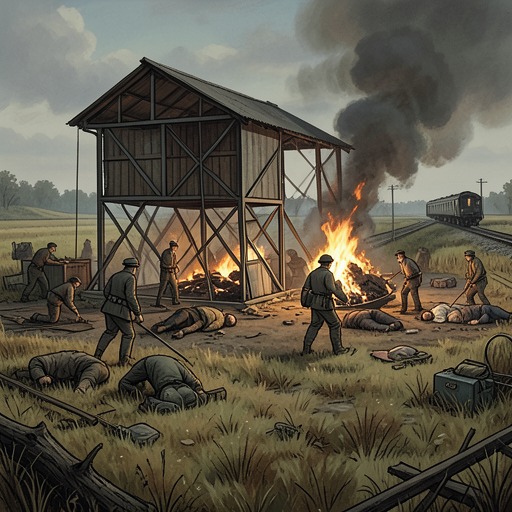
Spring Meadow corpse-burning operation
The Zone of InterestThe Spring Meadow corpse-burning operation is the camp’s attempt to destroy the bodies and traces of mass murder at a scale that defeats routine disposal. Under Paul Doll’s command, the work draws on military force, specialist labor, and improvised engineering; its increasingly systematic methods make the machinery of concealment inseparable from the violence it is meant to hide.
Mobilization and Arrival
Doll prepares for the operation as if assembling an exact instrument. At the ramp he stands with his chest out and fists on his hips, backed by Wolfram Prufer, three labour managers, six physicians, disinfectors, Szmul and twelve members of his team, eight Kapos, a hosing crew, ninety-six troops under Boris Eltz, a further eight-man unit with a heavy machine gun, and two flamethrowers. Ilse Grese and her platoon are also summoned, along with a seven-piece group of violinists from Innsbruck. The inventory is both a show of force and a grim administrative roll call: personnel for control, labor, medical supervision, and music are gathered around the same arrival.
Doll expects the familiar arithmetic of deportation, in which a train of about one thousand people might see as many as ninety percent selected to the left, but realizes that the usual guidelines will be of little use here. Special Train 105 arrives with a different-looking group: first, bewildered middle-aged stewards in civilian suits and white sleeve bands; then, among the passengers, a boy in a sailor suit, an elderly man in an astrakhan overcoat, and a bent old woman leaning on an ebony cane. The details unsettle the routine of selection before the work of disposal begins. What arrives is not an abstract count but a collection of distinct, vulnerable people, even as Doll’s preparations reduce the scene to a logistical problem.
Orders, Concealment, and the Contaminated Site
The operation’s purpose is made explicit in the argument between Paul Doll and Wolfram Prufer. Prufer calls the work impossible; Doll answers that the order comes from Gruppenführer Horst Blobel and therefore from Heinrich Himmler. The ashes, Doll insists, must also be ground. What might appear to be a technical instruction is presented as a political necessity: the perpetrators are covering their tracks. Prufer counters that concealment would matter only if Germany lost, and that victory would make the evidence irrelevant. Doll acknowledges the logic but still tells him to take the long view, imagining later investigators asking questions and probing into the past. His confidence in victory coexists with an insistence on preparing for its opposite.
That effort to manage the evidence collides with the material consequences of the operation. After tasting the water, Doll tells Prufer that a delegation of local officials in the Old Town had complained that it remained undrinkable however often it was boiled. The pieces have begun to ferment, he says, and the water table has been breached; there is no alternative, and the smell will become overwhelming. Prufer replies that it is already unbearable. The exchange turns disposal into a crisis that cannot be confined to the work site: contamination has reached the water, and the stench is already perceptible to those compelled to deal with it. Doll responds not by reconsidering the work but by reprimanding Prufer for complaining.
When Doll returns to Sector 4IIIb(i), the Spring Meadow is audible before it is fully in view. He had last visited in July, during Heinrich Himmler’s day-long inspection; now, as he climbs from the truck with Szmul, he hears popping, splatting, and hissing from beyond the mound. The sound and smell precede the spectacle, binding the landscape to the work being done there. Doll surveys the field while insisting to himself that he is a normal man and recasting kindness to Jews as cruelty to Germans. That self-justification sits beside the physical evidence of the meadow: the operation has transformed a place into an active site of burning, while its commander tries to translate what he sees into the language of political duty.
Prufer recalls that at Chełmno, Blobel had tried to dispose of bodies by blowing them up. The attempt had not solved the problem: the upper parts were left behind. The recollection supplies a failed precedent rather than a workable answer, and Doll’s question about what the explosions were meant to achieve exposes the inadequacy of treating destruction as a simple technical task. The field before them is not an abstract problem of disposal; it is a vast, visible consequence that resists being made to disappear.
Engineering the Pyre and Counting the Dead
The first attempts at burning the bodies, using wooden planks in modest accumulations, made little progress. Doll’s account credits Szmul with the practical proposals that turned these failures into a continuous system: there was to be one pyre, kept alight around the clock, with liquefied human fat used to sustain combustion. Szmul organized run-off gutters and teams to ladle the fat onto the fire, a method Doll also values for reducing gasoline consumption. The language of efficiency does not soften the operation; it shows how the destruction of bodies is recast as a problem of fuel, labor, and uninterrupted production.
The apparatus grew into a vast lattice of warped railway tracks, which Doll compares in scale to the cathedral in Oldenberg. Workers used wide ladders and hoists to load the structure, then retreated to wheeled towers from which they fed bodies into the fire, sometimes by the bucketful. From the mound, the towers seemed to Doll like siege engines. At night the rails glowed red, and he says the image persisted for him as a gigantic black toad with illuminated veins. The striking comparison registers the scene’s oppressive scale while also revealing how the commander’s imagination turns the machinery of mass killing into an uncanny spectacle.
The system’s practical difficulties did not end with keeping it alight. The heat made it impossible to approach the fire, while its nocturnal blaze provoked an angry complaint from Lothar Fey of the Air Defence Authority. Even this intrusion becomes, in Doll’s telling, another irritation to manage: the operation’s visibility and physical intensity generate consequences beyond the pyre, but the administrative response is to adjust the work rather than halt it.
Counting the remains offered a parallel test of technical procedure. Doll initially orders that skulls be counted, but the Sonderkommando leader’s alternative proves more reliable. Because many victims had been killed by standard shots to the neck, often fired hastily or clumsily, their skulls were frequently splintered. The camp therefore counts femurs and divides the total by two. The calculation turns bodily remains into an estimate of people killed, with the method’s clinical precision resting on the damage inflicted during murder.
The burning operation is only one stage in a wider chain of handling. Members of the Sonderkommando drag bodies from the shower room to the Leichenkeller with thick leather belts, remove gold teeth with pliers and chisels, cut off women’s hair, and take earrings and wedding bands. They load the bodies onto a pulley in consignments of six or seven, raise them to the retorts, grind the ashes, and send the powder by truckload to the Vistula. Doll describes this work as callous and emphasizes that the victims are the workers’ fellow Jews; his accusation directs attention toward the coerced prisoners’ apparent detachment, while the sequence he records exposes the organized stages through which the camp strips, processes, and disperses the dead.
Concealment, Responsibility, and the Landscape Left Behind
The work at Spring Meadow belongs to a larger policy whose decisive turn the novel locates in a letter dated July 31, 1941. Drafted by Eichmann and Reinhard Heydrich and signed by Goring, it conveyed Hitler’s wish for a total solution and authority to begin. The account presents extermination not as a single, fully specified technical plan but as a process that hardened under pressure: as victory over Russia receded, deporting Jews to a distant, barren place seemed less viable, while officials in Poland competed to solve the problem of millions more people brought under German rule. The shift to killing women and children marks the moral threshold crossed before operations such as the one at Spring Meadow made mass murder and the destruction of its evidence into organized work.
The effort to erase the traces repeatedly produces new traces. Doll orders the remains ground because the perpetrators are covering their tracks, but the operation’s scale defeats the fantasy of a clean disappearance: the water table is breached, the water becomes undrinkable, and the smell spreads beyond the immediate site. During a later drive, Doll keeps stopping to lean out of the vehicle and sniff; the stench is, in his account, worse than he has ever known and continues to intensify. The recurring act of smelling turns concealment into a bodily encounter with what cannot be contained. The operation changes not only the ground where bodies burn but the surrounding environment through which its consequences travel.
Doll’s own reflections expose the distance between the language of duty and the evidence before him. After the Reich Day of Mourning, he asks why the meadow was made to churn and spit, why the place reeks, and why the snow has turned brown. His questions do not lead to a repudiation of the crimes; instead, they register a crisis in the explanations that had allowed him to carry them out. The wall placard declaring that loyalty is honour remains beside his meditation on Kadavergehorsam, obedience named through the image of a corpse. In that comparison, the dead are not the only bodies rendered lifeless by the system: the obedient perpetrators, too, appear spiritually extinguished. The pyre’s technical success therefore cannot amount to erasure. Its smoke, stench, contaminated water, and altered landscape preserve the consequences that Doll’s administrative procedures were designed to make disappear.